+86-21-20919968


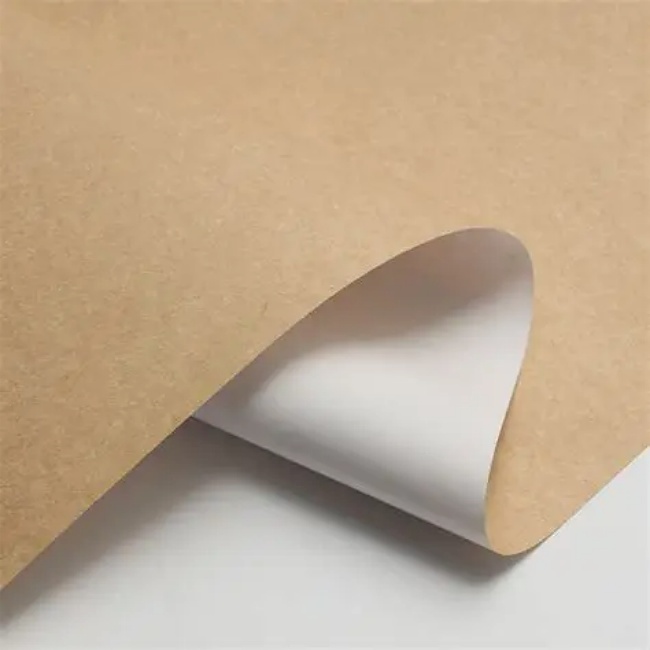
Coated Kraft Back Paper is a packaging paper that combines the high strength of kraft paper with excellent printing adaptability of coated paper. It is usually coated with a white layer on one side and brown cowhide pulp on the other side, commonly known as "white faced cow card" in China.
Meaning and Raw Material Processing
Meaning: It is a product made by coating and processing on the surface of kraft paper (substrate). Its structure is usually multi-layered, with the surface layer coated with bleached pulp and the bottom layer often using waste pulp or unbleached pulp to balance cost and strength.
Raw materials:
Surface layer (coating surface): Bleached sulfate needle pulp is usually used to ensure whiteness and surface strength.
Bottom/core layer: Unbleached kraft needle pulp (retaining cowhide color) or waste pulp (such as OCC waste paper) is often used to provide stiffness and reduce costs.
Process: After multiple layers of mesh forming, the base paper is coated with pigments on the surface layer. The coating methods include scraper coating, film transfer coating, etc., with the aim of filling in the unevenness of the kraft paper surface, improving smoothness and glossiness, and thus achieving good printing results.
Technical Indicators
Quantification and coating amount: The common quantitative range is wide, and research data shows that the coating amount is usually between 12-40g/m².
Smoothness and glossiness: This is the core purpose of coating. Depending on the quantity, the smoothness can reach 50-200 seconds, and the glossiness is about 50% -60%, which can effectively improve the reproduction of printing dots.
Strength index: Retains the strength advantage of kraft paper. For example, the burst resistance index is about 2.2-2.8kPa·m²/g, the ring pressure index is about 12.0-13.0N·m/g, and the burst resistance is good.
Whiteness: The surface whiteness is usually controlled at around 80%-82% (ISO standard).
Conventional Weight and Size
Weight: Wide range, commonly ranging from 120g/m² to 450g/m². The mainstream packaging applications are mostly concentrated between 175g/m² and 350g/m².
Size: mainly divided into two types: roll and flat. The common specifications for roll width can range from 600mm to 2500mm; Flat sheets are usually supplied in regular sizes (such as 787×1092mm) or large sizes, and can also be customized according to demand.
Characteristics
Good printing adaptability: The coating surface is smooth and can present exquisite color printing effects, making up for the rough surface of ordinary kraft paper.
High physical strength: Inheriting the high anti explosion and anti tear characteristics of kraft paper, it can provide good protection for the contents.
Food contact safety: Some compliant products (such as imported brands) do not contain fluorescent agents, comply with FDA and other standards, and can be directly used for food packaging.
Moisture and frost resistance: Some specific models have been treated to prevent deformation in refrigerated or frozen environments, while maintaining stable strength.
Usage
High end packaging: Used for electronic products, household appliances, cosmetics, toys, alcoholic beverages, and other products that require exquisite printing and certain protective color boxes.
Food packaging: bundle packaging for yogurt and beverages, as well as packaging for direct contact foods such as pizza, pastries, and fast food boxes.
Heavy or special packaging: replacing some corrugated cardboard for packaging automotive parts and hardware tools; Or used for packaging frozen food that requires refrigeration.
The core value of Coated Kraft Back Paper lies in its combination of the strength of kraft paper and the printing performance of coated paper - the surface coating solves the problem of rough and difficult to print on ordinary kraft paper, while the bottom kraft pulp or waste paper pulp retains the physical protection ability of anti explosion and anti tear. As a result, it is capable of handling high-end color boxes that require color printing and certain protection for electronic products, cosmetics, alcohol, etc. It can also be used in food contact scenarios such as yogurt bundles and fast food boxes, and can replace some corrugated cardboard for heavy-duty packaging such as hardware and auto parts. In practical selection, it is recommended to focus on three aspects based on specific applications: whether the weight and coating amount match the printing accuracy and stiffness requirements, whether the crush resistance index and environmental pressure index meet the stacking and transportation strength, and whether there is compliance with food contact certification when used for food packaging. With the continuous increase in demand for "high strength+high printing quality+recyclability" in the packaging industry, there is still room for further expansion of the application space of Coated Kraft Back Paper in high-end color boxes and food packaging fields.


